
Garden myths · Aug 5, 2026 · By Nell Harding
The wrongly accused: a defense of the garden's scariest workers
The spider, the toad, the mole, the snake, and the giant wasp. Every one of them is on your side, and this is their day in court.

Every garden has a night shift and a security detail, and most of its members have terrible reputations. The spider gets the broom. The mole gets the trap. The snake gets the shovel, the big wasp gets the spray can, and the toad mostly gets ignored, which by comparison is a kindness. This entry is the almanac's case for the defense: the garden's most feared residents, taken one at a time, with the charges read and the actual evidence heard. Nearly every verdict comes back the same way, because the creatures that scare gardeners most are, almost without exception, the ones working hardest for them.
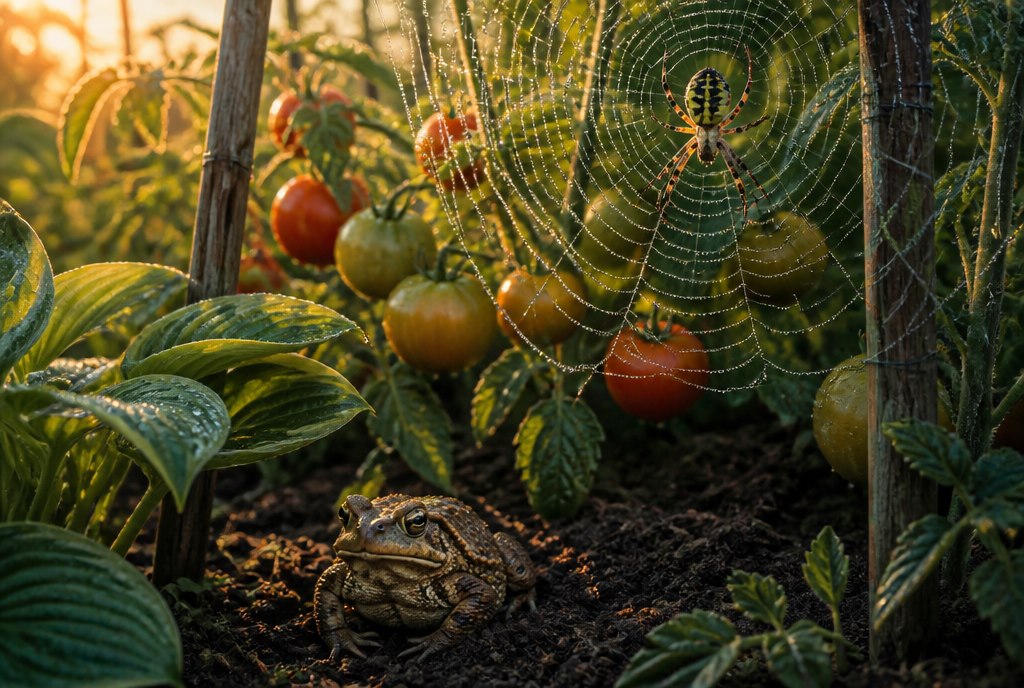
Start with the one that makes people drop the watering can: the big yellow and black garden spider, the orb weaver who strings her wheel between the tomato stakes in August. She is not hunting you. She has poor eyesight, no interest in anything she cannot wrap, and a web that runs a nightly interception of moths, beetles, flies, and grasshoppers that would otherwise be eating your beds. The bold zigzag stitched down the middle of her web is called a stabilimentum, and one honest reading of it is a warning flag for birds, so they do not fly through her work. She rebuilds much of the web each night, eats the old silk to recycle it, and asks only to be left where she is. A garden with orb weavers in September is a garden that ran pest control all summer.
The daddy longlegs carries the strangest charge sheet of all: deadliest venom in the garden, fangs too small to bite. It is a campfire story, and every part of it is wrong. The daddy longlegs, the harvestman, is not even a spider. It has no venom glands and no fangs at all, it cannot bite you, and it spends its days cleaning up aphids, mites, decaying leaves, and soft-bodied pests. It is closer to a tiny, harmless, eight-legged janitor than to anything deserving fear. The most feared creature in the garden turns out to be one of the most defenseless things in it.
The toad is the ally most gardens already have and never thank. A single toad eats slugs, cutworms, beetles, and earwigs by the thousands in a season, working the exact hours the slugs work and asking for nothing but shade and a little moisture. Where the slug entry in this almanac talked of beer traps and copper tape, the toad is the version that never needs refilling. Tip a broken clay pot on its side in a damp corner, keep a shallow dish of water nearby, and you have hired the best slug patrol available at any price.
The mole is the great case of mistaken identity. He is convicted every spring of eating bulbs and roots, and he is innocent: moles are insectivores, and what they are actually doing down there is eating grubs, including the larvae of the beetles whose adults chew your leaves. The real bulb thief is the vole, a mouse-shaped vegetarian who borrows the mole's tunnels the way a burglar borrows an open window. The mole dug the tunnel hunting your grubs; the vole moved in behind him and ate your tulips; the mole took the blame for both. Yes, the tunnels lift the lawn, and a board pressed over the run settles most of it. But a yard with moles is a yard being deloused from below.
The garter snake clears more slugs than any remedy in the shed. A single garter snake can eat hundreds of slugs in a summer, along with grasshoppers and the occasional vole, and it can do nothing to you: garter snakes are harmless to people, shy to the point of comedy, and gone the moment they feel your footstep. The flat stone that warms in morning sun, the unmowed strip along the fence, the log left where it fell: these are the wages the snake works for. A gardener who shrieks and reaches for the shovel is destroying the best slug control north of the toad.
Now the case that empties patios: the cicada killer, the giant wasp of high summer, two inches of hornet-striped menace digging burrows in the lawn. The reputation is pure costume. The males, the ones that dive and hover and patrol at face height, cannot sting at all; no male wasp can. The females can sting but essentially never do; they are single-minded miners provisioning burrows with cicadas and have no colony to defend, which is what makes their social cousins testy. The cicada killer is a solitary farmer in a scary jacket, aerating your lawn for free and thinning the cicadas that scar your young tree branches.
The ground beetle is the reason the almanac keeps telling you not to squish the big black beetle hurrying across the path at dusk. He is not heading for your plants; he is starting a shift. Ground beetles run all night at soil level, eating slug eggs, cutworms, root maggots, and caterpillars, and one beetle can clear its own weight in pests in a night. The mulch the mulch entry praised is his highway system. He is the night watchman of the whole operation, and he dies most often under the boot of the very gardener he works for.
The earwig deserves the honest split verdict this almanac promised to always give. The ear part of his story is medieval nonsense: earwigs do not seek out ears, and the name is an old slander that stuck. In the garden he is a genuine double agent, doing real damage to soft seedlings and dahlia petals some seasons, and in others quietly clearing aphid colonies off the fruit trees at night. Orchardists actually recruit earwigs for aphid control. The fair sentence: watch what he is doing in your particular yard before passing one.
The hoverfly earns an acquittal plus a medal. That little wasp hovering over the flowers, the one that makes visitors flinch, cannot sting anyone: it is a fly in a wasp costume, wearing borrowed stripes because looking dangerous is cheaper than being dangerous. Hoverflies are among the best pollinators in the garden after the bees, and their larvae are aphid specialists that eat hundreds apiece. Two jobs, no sting, and still it gets swatted for the uniform.
The night shift deserves its own honorable mention, because it is mostly invisible and mostly slandered. A single bat clears hundreds of flying insects in an evening, including the moths whose caterpillars top the pest lists, and it wants nothing to do with your hair; that story is as empty as the earwig's. The opossum wanders through after midnight eating ticks, slugs, snails, and fallen fruit, is astonishingly resistant to rabies, and bothers precisely nothing. A garden that looks asleep at 2 a.m. is running a full second staff.
So how does a gardener retain this firm? Mostly by declining to fire it. Every broad-spectrum spray is a layoff notice served on allies and pests alike, and the pests, breeding faster, always rehire first. Beyond that, the wages are cheap: a log pile or stone pile for cover, a shallow water dish, a corner left slightly untidy, mulch for the beetles, and the flat warm stone for the snake. The pollinator entry taught planting for the day shift; this is the same hospitality extended after dark.
The closing argument writes itself. Fear in the garden points almost exactly backwards: the creatures that look most alarming, the big spider, the big wasp, the snake in the beans, are the ones doing the most work, while the actual thieves, the aphids and slugs and voles, look like nothing at all. The almanac's standing advice is to put down the shovel, read the charge sheet twice, and remember that a garden full of predators is not a garden in trouble. It is a garden that has hired well.
