
Garden myths · Aug 9, 2026 · By Nell Harding
A charm, a knot, a sparkle: the secret names of garden visitors
English keeps a hidden name for every gathering in your garden, and most of them are five hundred years old. Here is the full roll call.
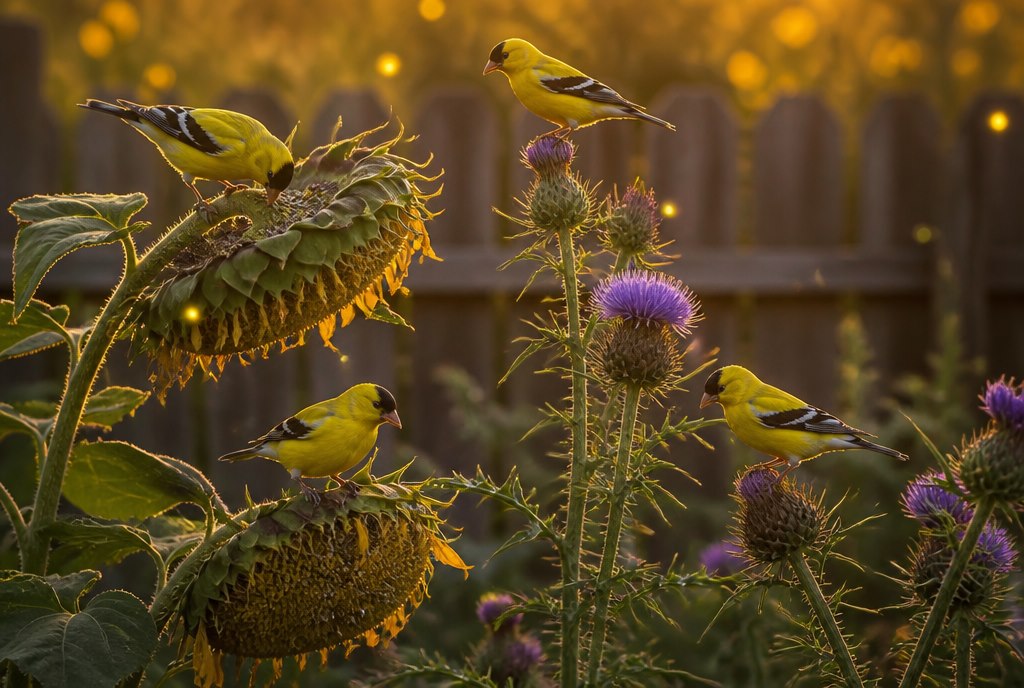

Stand in the garden on an August evening and you are surrounded by gatherings that have secret names. The goldfinches stripping the sunflower heads are a charm. The fireflies starting up along the fence line are a sparkle. The toads under the hostas are a knot, the moths arriving at the evening primrose are an eclipse, and the butterflies that worked the zinnias all afternoon were a kaleidoscope. English keeps a hidden second vocabulary for the creatures a gardener sees every day, and this entry is the almanac's full roll call: where the words come from, which visitors have earned one, and why saying them out loud changes the way an evening in the garden feels.
The words are older than almost anything else in the garden. Most of them trace to the fifteenth century, to lists called terms of venery that English hunting culture compiled as a kind of courtly word game, most famously in the Book of Saint Albans, printed in 1486. The lists began seriously, a herd of deer, a flock of sheep, and then grew playful and sly, assigning gatherings of every creature a name with a wink in it. Scholars argue about which terms were ever truly spoken in the field and which lived only on the page, and the almanac will be honest as always: some of these were word games from the start. Five centuries of gardeners repeating them has made them real enough.
The charm of goldfinches is the garden's best-timed example, because goldfinches run on a gardener's calendar. They are among the last songbirds to nest each year, waiting deliberately for late summer, when the thistles and sunflowers go to seed, so there is down for their nests and seed for their young. The charm that arrives at your seed heads in August is not passing through; it is commuting. The word charm may come from an old term for a blended chorus of voices, and anyone who has heard a seed head full of goldfinches talking at once knows exactly which sound the fifteenth century meant. Leave the sunflowers standing and the charm will visit every day.
A gathering of fireflies is a sparkle, and for once the old name is plain description. The June and July meadow show is courtship in code, each species flashing its own pattern, females answering from the grass. The light itself is nearly perfect chemistry, cold light that wastes almost no energy as heat. A sparkle needs what a manicured yard removes: tall grass at the edges, darkness, and soil left undisturbed where the larvae spend their year eating, it should be said, slugs. The wonder and the pest control come as a package.
Butterflies gather as a kaleidoscope, and the word earns itself best at the mud puddle. On hot afternoons, males of several species crowd damp ground to drink dissolved minerals, dozens of wings opening and closing out of rhythm, and the shifting-pattern name stops being fanciful and becomes reporting. A kaleidoscope can be hosted deliberately: a shallow dish of wet sand, a few flat stones for basking, and the zinnias and coneflowers the pollinator entry already ordered planted.
The toads under the leaves are a knot. Real toads spend most of the year solitary, one to a territory, which the slug patrol prefers anyway; the knot forms in spring at the breeding pond, a literal tangle of toads in the shallows, and the name is another case of the old lists simply describing what they saw. A gardener who finds even a loose confederation of toads sharing the damp corner behind the shed is hosting royalty, as the garden-allies entry argues at length.
Owls convene as a parliament, the most famous term on the list and one of the few with a traceable modern route: the image of solemn owls in assembly runs from Chaucer's parliament of fowls through C. S. Lewis, who put a parliament of owls in Narnia, and the phrase settled on the birds for good. The joke inside the word is that owls are not wise, just wide-eyed and inscrutable, which, as anyone who has attended a committee meeting knows, may be the same thing the word parliament was already winking at.
Squirrels operate as a scurry, which describes the work rate, and the work deserves a word here in the squirrel's defense. A scurry buries thousands of acorns and nuts each fall and fails to retrieve a fair share of them, which is to say squirrels plant forests by accident, oaks in particular. The gardener robbed of tulip bulbs in October is entitled to grumble, and the almanac's bulb-cage advice stands, but the tree line at the edge of town is partly the scurry's life work.
Crows assemble as a murder, the most theatrical term of all, and probably a simple slander from the birds' habit of attending gallows fields and battlefields in the old ballads. The modern evidence runs the other way: crows are among the most intelligent animals in the yard, they recognize individual human faces for years, remember who wronged them, tell their families, and hold what look uncomfortably like funerals, gathering silently around a dead crow as if taking attendance. A gardener on good terms with the local murder has an ally with a memory.
Starlings in motion are a murmuration, the one term everyone has seen on film even if they never heard the word: thousands of birds turning as one liquid shape over a winter field. The physics is as good as the word, each bird tracking only its half-dozen nearest neighbors, no leader anywhere, the whole shape emerging from small local rules. It is the best free air show of the cold months, and the word itself, a murmur made visible, may be the loveliest on the list.
And the moths that own the garden after dark are an eclipse. It is the newest-feeling and most poetic of the terms, the gathering that blots the light, and it names the shift most gardeners never watch: moths outnumber butterflies many times over and pollinate the pale, fragrant evening flowers, the primrose and moonflower and nicotiana, that the day shift never visits. Stand by the porch light some August night and count the wings; the eclipse has been working your garden all along.
Why keep these words? Because naming changes seeing. A yardful of birds is scenery; a charm at the seed heads is an event. The old lists were a game, but the game had a serious engine: paying close enough attention to a creature to give its gatherings a personality. That is the almanac's whole trade, and it is free to practice. Learn five of these, say them out loud to a child or a neighbor at the fence, and watch the garden reorganize itself into charms and knots and sparkles in front of you. The garden was already full of wonders; the fifteenth century just left us the field guide.
