
Garden myths · Aug 17, 2026 · By Nell Harding
The wheel bug: a full hearing for the scariest insect in the garden
Half a gear wheel, a folded beak, and a reputation for menace. The strangest-looking insect in North America is also one of the most useful things on your roses.
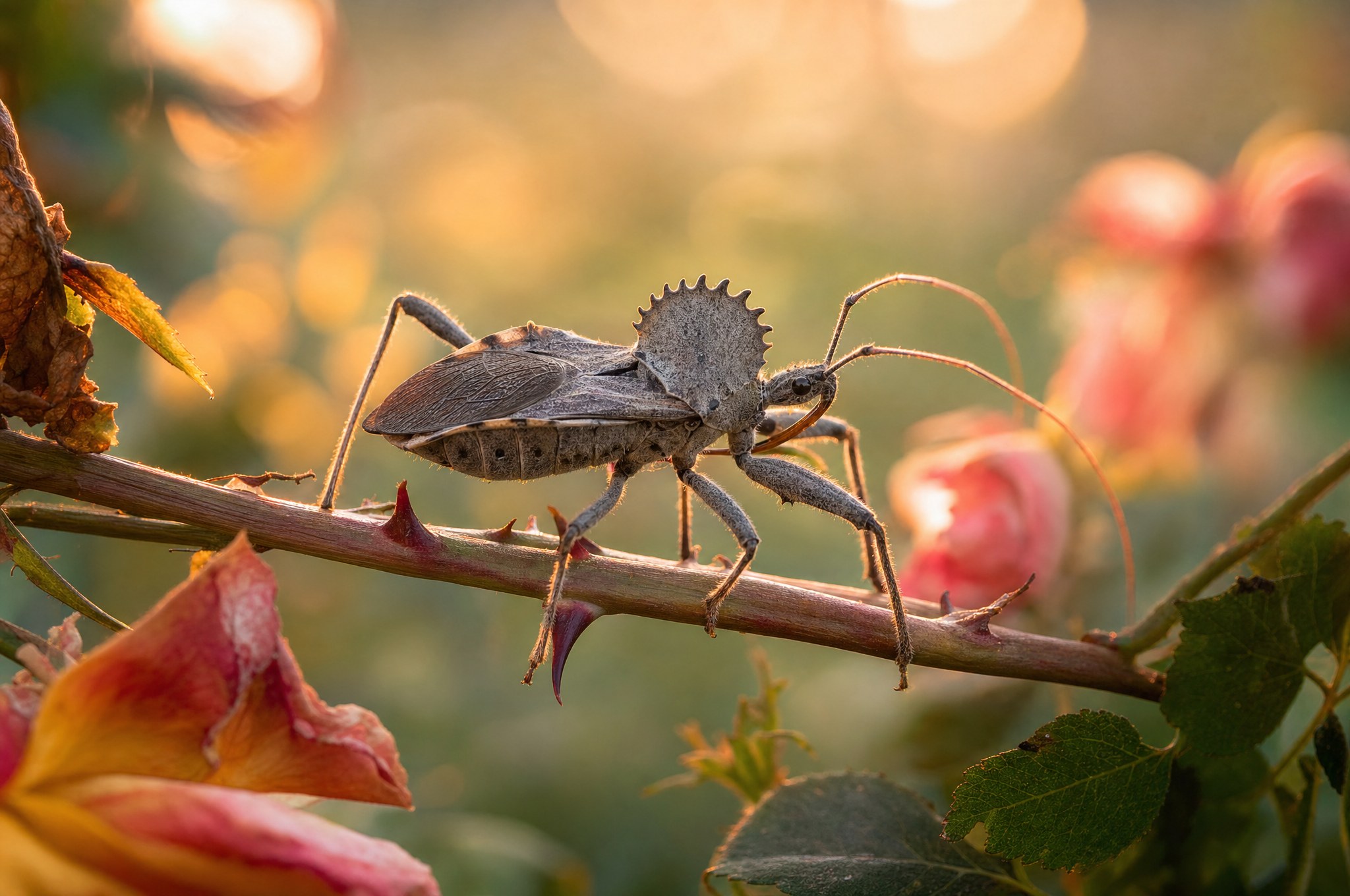

Every August, somewhere in America, a gardener meets a wheel bug for the first time and takes a full step backward. It is an understandable step. The wheel bug looks like something assembled from spare parts of older, harsher eras: gray plate armor, a narrow head on a neck that seems too long for an insect, a thick beak folded under its chin like a jackknife, and, rising out of its back, the thing no other insect in North America carries, half a gear wheel, a neat semicircular crest of a dozen or so teeth. People who find one on the tomato stakes tend to assume it escaped from somewhere. This entry is its full hearing, because the strangest-looking resident of the garden is also one of its most valuable employees.
Start with the name on the docket. The wheel bug, Arilus cristatus, is the largest assassin bug in North America, an inch and a half of it, and the assassin family is exactly what it sounds like: hunters that stalk other insects and dispatch them with that folded beak. The family resume is the first point for the defense. Assassin bugs do not chew leaves, bore stems, suck plant sap, or touch anything green. Every calorie a wheel bug has ever eaten was another insect, and in a vegetable garden in late summer, the insects on offer are overwhelmingly the ones you have spent the season fighting.
The menu deserves to be read aloud. Japanese beetles, the bronze-and-green scarabs that skeletonize roses and grape leaves, are a documented staple; the wheel bug is one of the few native predators that takes them as adults, armor and all. Brown marmorated stink bugs, the ones that pile into the beans and later into your window frames, are another favorite, and entomologists have pointed to the wheel bug as one of the best native answers to that imported plague. The list runs on through tent caterpillars, fall webworms, cabbage loopers, sawfly larvae, and aphids by the colony when nothing larger presents itself. Almost everything a wheel bug eats is something a gardener would have paid to remove.
The hunting style explains the build. A wheel bug does not chase; it stalks. It moves along a cane or a branch a step at a time, slow as a minute hand, forelegs raised, and closes the last inch in a single reach. The long neck lets it aim. The beak does the rest, and the whole business is over in seconds. It is the mantis method run by a tank, and it works because the wheel bug's prey, beetles especially, are armored against nearly everything except a hunter patient enough to find the seam.
Now the charges, because there is one honest count on the sheet. Can a wheel bug hurt you? Yes, and this almanac deals plainly: a mishandled wheel bug can deliver a defensive bite that hurts more than a bee sting, and people who have collected both say the wheel bug wins by a comfortable margin. The pain fades over a few hours, does no lasting harm to most people, and that is the entire extent of the danger. Set beside the reputation of its own face, it is a modest rap sheet.
But hold the two halves of that fact together, because the second half acquits her. A wheel bug bites when it is grabbed, pinned, or pressed against skin, and essentially never otherwise. It does not defend territory, does not swarm, has no nest to protect, and wants nothing you have except your beetles. Bother one and its usual response is to drop off the leaf and walk away with as much dignity as the armor allows. The rule of engagement is the same one this almanac gives for the garden spider and the cicada killer: hands off, and the danger rounds to zero. You never needed to pick her up. Nothing in the job description requires it.
About that wheel, since it is the reason you stepped back. No one has settled what it is for. It appears on no other insect on the continent, males and females both carry it, and the honest scientific answer after two centuries of looking is a shrug: possibly a warning to birds, possibly armor against exactly the kind of predator that would grab it across the back, possibly a badge whose meaning mattered more in some earlier chapter of its line. The almanac enjoys this. A garden that still carries an unsolved mystery on six legs, in plain sight, on the rose cane, is a garden worth walking slowly.
Meet the rest of the family while court is in session, because the wheel bug does not work alone. Her nymphs hatch in spring from a neat mass of brown, bottle-shaped eggs glued to bark or a fence board, and they emerge looking like tiny red-and-black ants with attitude. They cannot fly, they cannot wheel, and they are eating aphids from their first week. Losing the egg mass to a well-meant scrape of the pocketknife costs the garden a hundred small hunters. If you find a patch of little brown bottles on the fence in winter, you have found next summer's security detail in storage.
The seasonal timing is why August is when the meetings happen. Wheel bugs overwinter as eggs, spend the early summer growing through their nymph stages, and reach full adult size, wheel and all, in late July and August, exactly when Japanese beetle season peaks. That is not a coincidence a gardener should interfere with. The biggest, most visible wheel bugs of the year arrive precisely when the garden's beetle problem does, and the two facts are related in the most useful possible way.
What should a gardener actually do on meeting one? Nothing, and the doing of nothing can be done well. Do not spray it, obviously; a broad-spectrum insecticide aimed at a wheel bug is friendly fire of the clearest kind, and the sprays entry of this almanac already priced out what those cost the ladybugs and lacewings. Do not relocate it; it chose the rose cane because the commute was short. Point it out to children from a respectful foot away, because a wheel bug at close range is the best free natural-history lesson the yard will offer all month. Then leave it to its shift.
If you want more of them, the recruiting poster is the same one the almanac keeps printing. Skip the broad-spectrum sprays, because assassin bugs are slower to rebuild than the pests they eat. Leave some rough edges, unmowed strips, a brush pile, standing stems through winter, because that is where eggs ride out the cold. Grow a garden with layers, flowers among the vegetables, shrubs near the beds, because stalking hunters need cover to work from. None of this is new advice; it is the same habitat prescription that hired the ground beetles and the hoverflies. The wheel bug simply signs on wherever that poster hangs.
So the verdict, and it is not close. The wheel bug is guilty of looking like a gargoyle and of defending itself when grabbed, and innocent of everything else it has ever been accused of. In exchange for being left alone, it removes the garden's worst beetles, its imported stink bugs, and its tent caterpillars, patrols July through frost without wages, and carries the only unsolved cog wheel in North American entomology past your kitchen window while it works. The scariest thing in your garden has been on your side the whole time. The least a gardener can do is stop reaching for the shoe.
